
Masoor tadka dal is a delicious Indian lentil curry made with red lentils. It's easy to make, flavorful, and healthy as well as naturally vegan and gluten free!
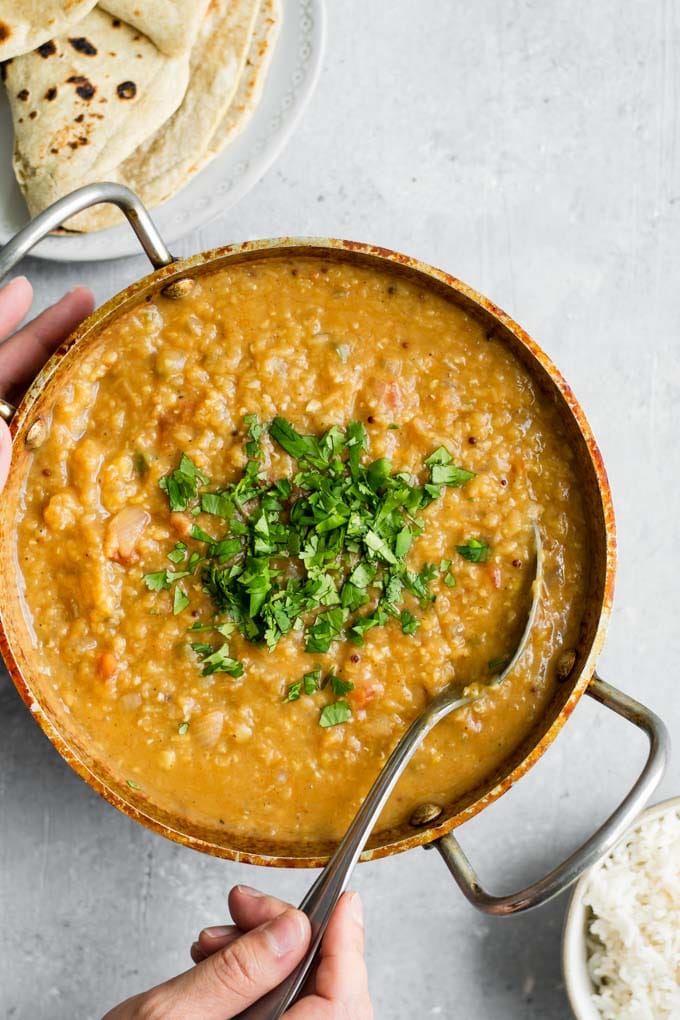
Dal (also spelled dhal or daal) is one of the most versatile, healthy, filling, and delicious meals. Dal translates to lentil, but when referred to in the context of food it means a spiced Indian lentil soup.
Dal can be made thick or thin, and with any kind of lentil. It can be made with cream and butter, or with a simple tempering of spices. No matter how how it's made, it's sure to turn out tasty.
Masoor dal is the same thing as red lentils, which are popular and easy to find at many grocery stores in the US. They're super cheap and cook quickly making them a great choice for a simple weeknight meal.
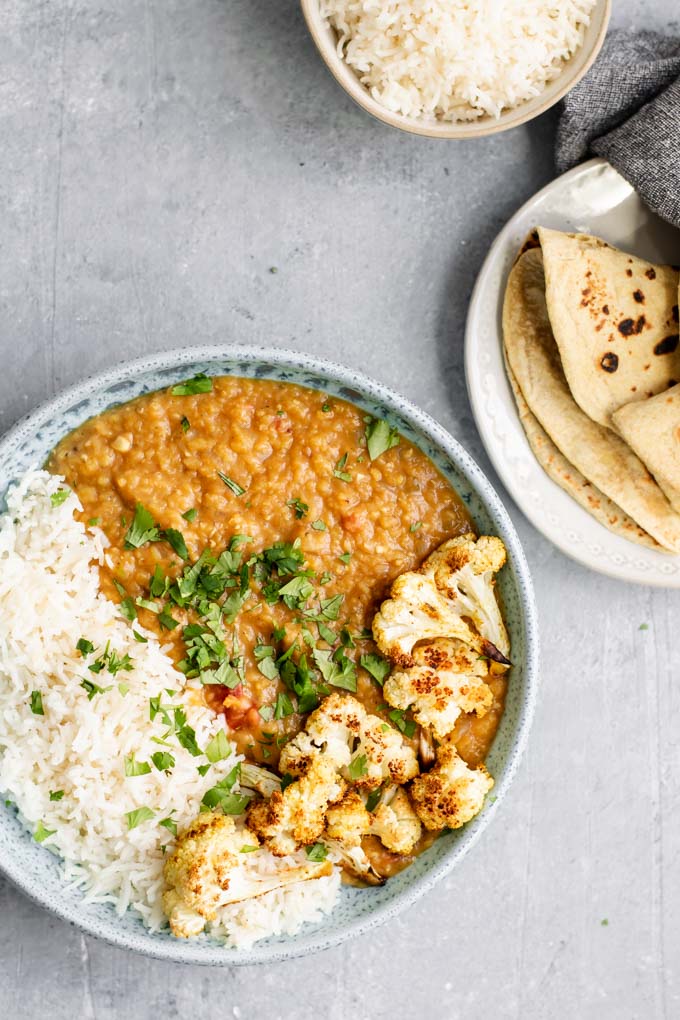
This recipe is naturally gluten free, high in fiber and protein, low in fat and calories, and packed with flavor. You'll find yourself coming back for bowl after bowl of dal. Serve with some basmati rice and if you'd like a veggie filled curry or some simple curry roasted vegetables for a complete meal.
You can feel good knowing that with each delicious serving of masoor dal you are getting important nutrients like folate, iron, phosphorous, potassium, magnesium, manganese, and zinc.
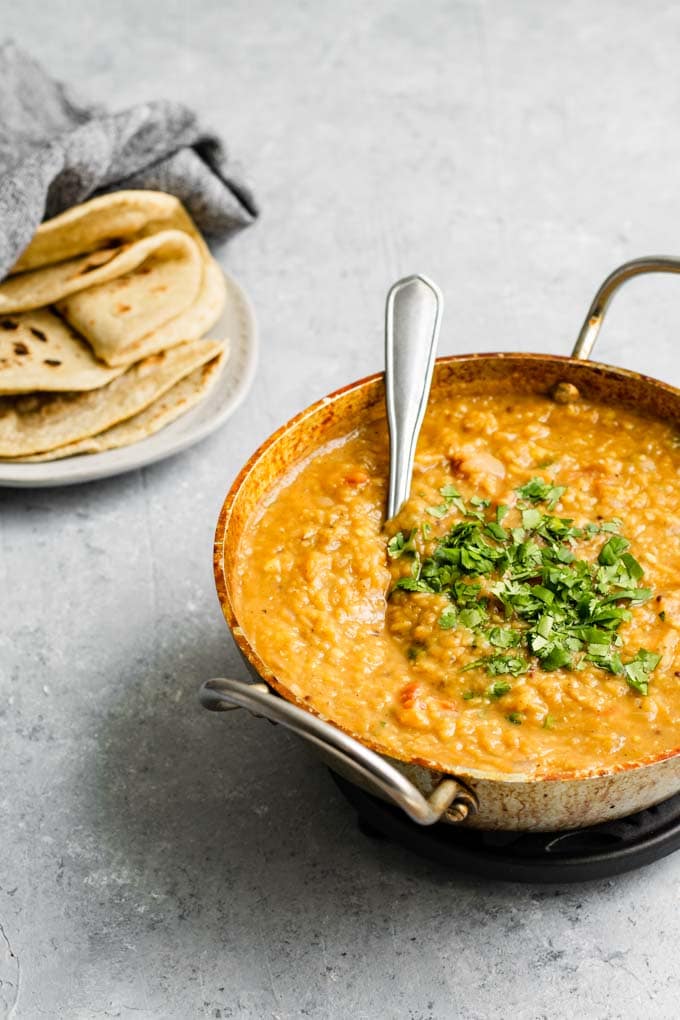
What is a tadka?
A tadka is a cooking method where spices and other aromatics are cooked briefly in hot oil to bring out their best flavor. It then gets added to a sabzi (vegetable curry dish) or dal (lentil curry) to infuse that recipe with its flavor.
It's a brilliant way to create delicious dal, as it allows for the varied cooking times of different kinds of lentils. Even from batch to batch of lentils the cooking time can vary, as fresher dried lentils will cook faster than old lentils that have been sitting on the shelf for a couple of years.
Cooking the lentils separately allows them to get to the perfect level of tender before adding the flavorings. It gives a chance for the tomatoes to cook without inhibiting the cooking of the lentils (only add tomatoes after the lentils are tender or they may never fully cook)! And keeps the onions from getting too soft, which gives a bit of texture to the final soup.
Having this texture from the tadka is particularly important with masoor dal which will pretty much completely break down when cooking.
Cooking the lentils:
Before cooking any lentils, be sure to sort through them for any debris or stones. These days the mechanical sorting is quite good, but I'll still find the occasional small stone no matter what brand I buy, and no one wants to bite into one!
I easily do this by measuring out the lentils, then pouring them onto a white dinner plate in portions so I can quickly visually go through them. Once inspected, I move them into a fine mesh strainer and once I've gone through all the lentils I rinse them very thoroughly.
Rinse the lentils until the water runs off clear, and while you could just run lots of water over the lentils in a strainer, I prefer to rinse, then put the lentils in a pot and add water to cover before swishing around with my hands. The water will turn cloudy, then drain out that water and repeat adding water to the pot and swishing around until the water runs clear.
Once the lentils are rinsed, add them back to the pot with fresh water. Bring the water to a boil, and if you see any white foam at the top of the pot, skim off what you can.
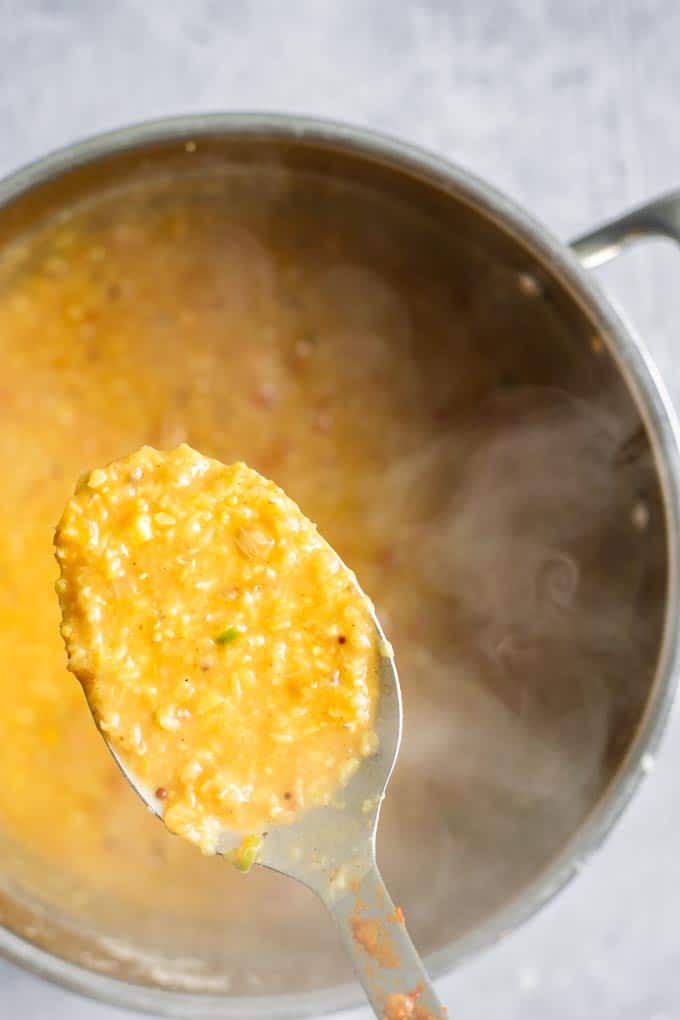
Then turn the water down to a simmer, partially cover, and set a timer. When the lentils are done they'll be tender but still have some texture. They'll cook another 5 minutes once the tadka is added, so try not to over do it in this first round of cooking!
While the lentils are cooking, make the tadka.
As explained before, the tadka is where alllll the flavor comes in to the dal.
Heat some oil, fry aromatics like onion, garlic, ginger, and chiles until they're soft. Then add spices: curry powder, mustard seed, coriander, and cumin. Add plenty of salt, as salt is what blooms the flavor on our tastebuds.
As we're mainly using ground spices which burn easily, we just briefly let them sizzle along with the onion mixture before adding tomato.
Cook the tomatoes until the tadka is thick and saucy.
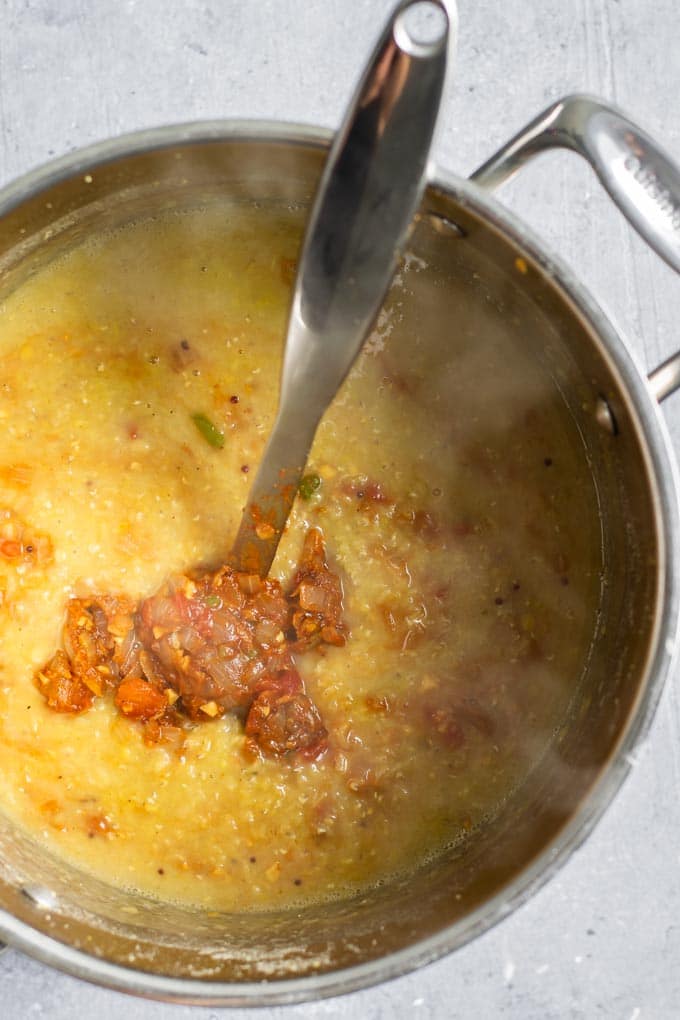
Add the tadka to the cooked lentils.
Let the two simmer on low together for just a few minutes to help the flavors meld. Taste the dal and add more salt to taste. If the dish tastes flat, or like it's missing something, chances are it just needs more salt.
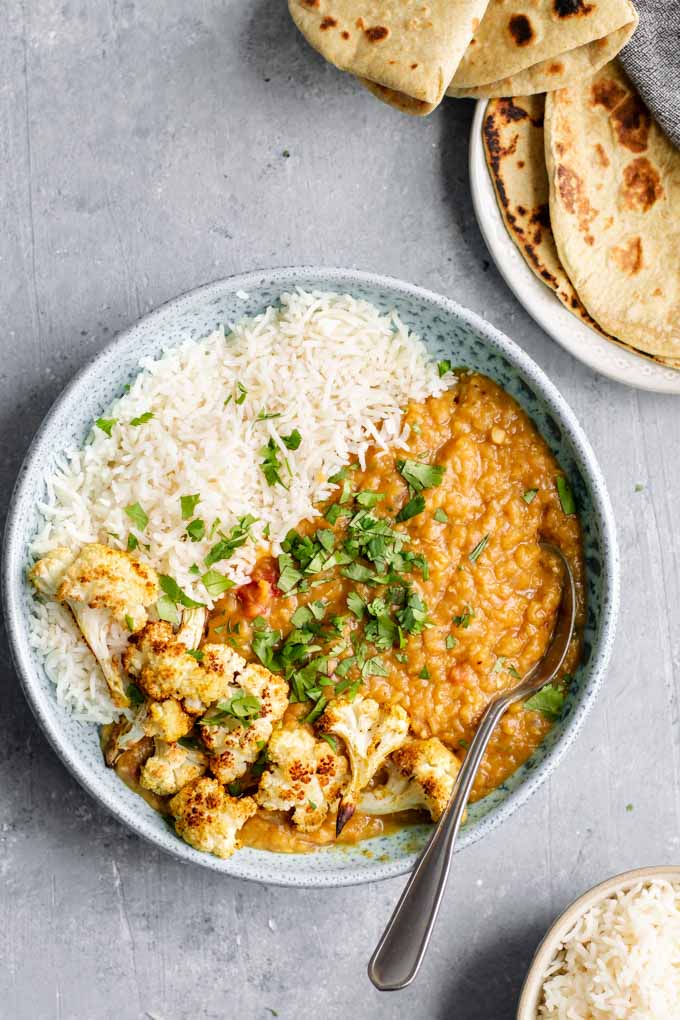
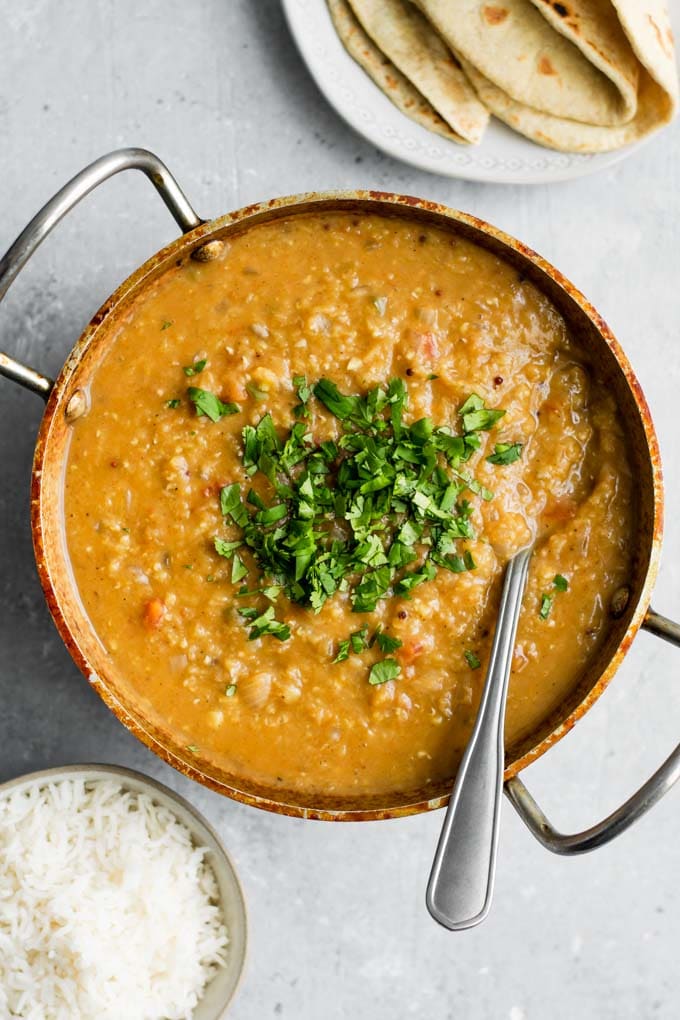
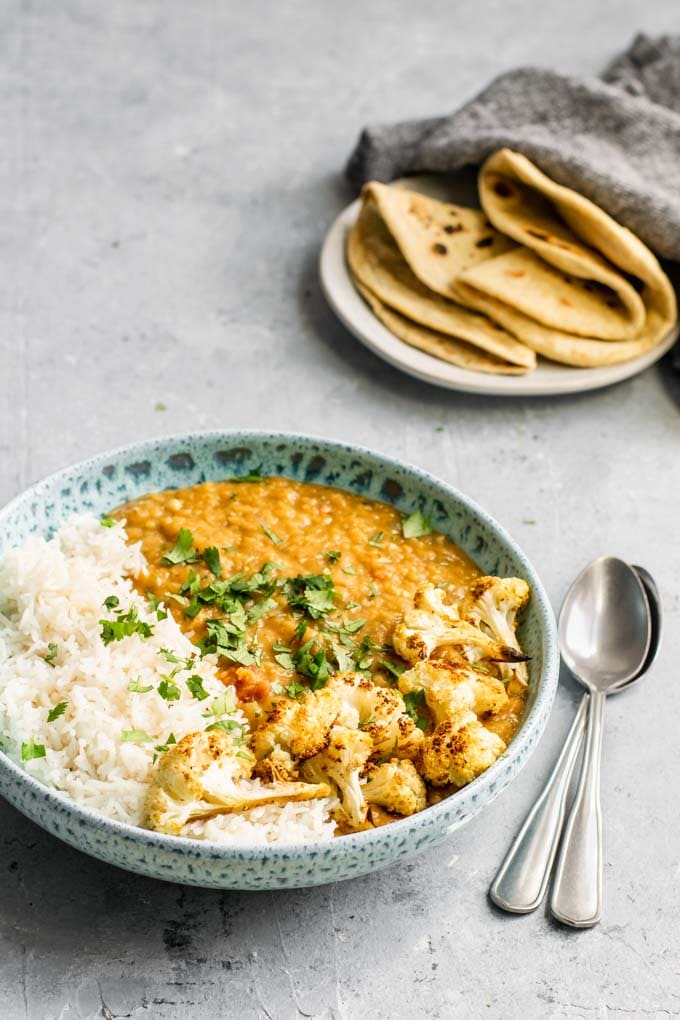
Serve hot with cilantro to garnish and a side of basmati rice.
It's also great served with some Indian bread such as homemade naan or chapati (pictured). I roasted up some cauliflower with curry powder to make this a complete meal.
If you enjoy dal, check out some of my other dal recipes, and some other Indian recipes while you're at it!
If you make this masoor dal tadka, leave a comment below and rate the recipe on the recipe card. And please share your photos with me on Instagram, tag @thecuriouschickpea and #thecuriouschickpea. I love seeing your recreations!
WANT MORE DELICIOUS VEGAN RECIPES? SIGN UP FOR MY EMAIL NEWSLETTER AND FOLLOW ME ON INSTAGRAM, FACEBOOK, AND PINTEREST!
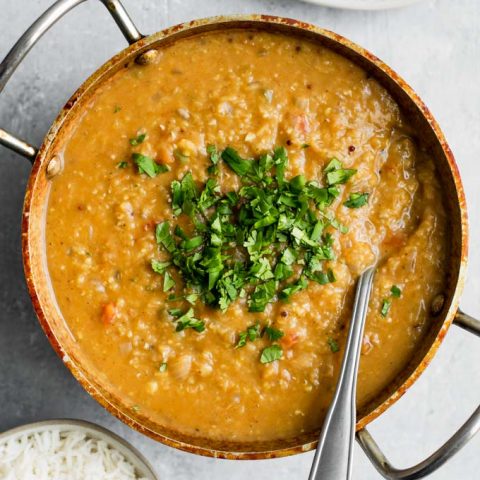
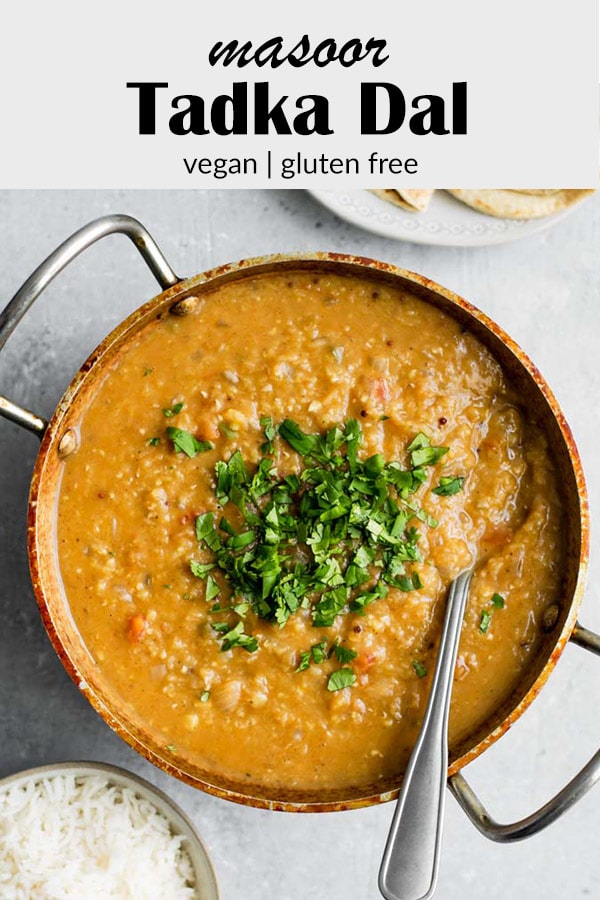
Masoor Dal Tadka - Indian Red Lentil Dal
Masoor dal tadka is a delicious Indian lentil curry made with red lentils. It's easy to make, naturally vegan and gluten free, and full of flavor.
Ingredients
- 2 cups dry masoor dal (aka red lentils), sorted and well rinsed
- 8 cups water
- 1 tablespoon oil (coconut oil or neutral flavored)
- 1 large yellow onion, finely diced
- 6 cloves garlic, minced
- 1 tablespoon minced ginger
- 2 green chiles, minced (can be seeded for less heat, use more or less to taste)
- 1 tablespoon Indian curry powder
- 1 teaspoon whole mustard seed
- 1 teaspoon ground coriander
- ½ teaspoon ground cumin
- 1 ½ teaspoon salt, more to taste
- 15 oz can diced tomatoes, or 1 ½ cups chopped fresh tomatoes
- cilantro, for garnish
- basmati rice, to serve
Instructions
- Combine the lentils and water in a large pot. Bring to a boil, then turn the heat down to simmer. Skim off any foam that collects on top. Cook, partially covered, until the lentils are tender, usually 15-20 minutes.
- While the lentils are cooking, make the tadka. Heat a skillet over medium heat and add the oil and onion, garlic, ginger, chiles, and a pinch of salt. Fry until soft, about 5 minutes.
- Add the spices: curry powder, mustard, coriander, and cumin, along with the salt. Stir to combine and cook for about 60 seconds, then add the tomatoes. Cook about 7 minutes to cook down the tomatoes if canned, or until the tomatoes are soft and saucy if fresh.
- Add the tadka to the cooked lentils, and simmer over low heat for about 5 minutes to infuse with flavor.
- Serve garnished with cilantro and with basmati rice.
Notes
Cook time can vary for lentils depending on how fresh they are. Very fresh lentils take less time to cook, whereas if they've been sitting around for a couple of years they may take longer.
Recommended Products
As an Amazon Associate and member of other affiliate programs, I earn from qualifying purchases.

Nutrition Information:
Yield: 8 Serving Size: 1Amount Per Serving: Calories: 263Total Fat: 5gUnsaturated Fat: 4gSodium: 514mgCarbohydrates: 43gFiber: 8gSugar: 4gProtein: 14g

This dish is most delicious !
From UK, so not used to using cups. 2x cups came out as just under a kilo, and 8x cups of water was far too much. I also found it a bit bland. Next time I'll use half the amount of lentils/ water, adding more chilli, cumin, ginger, salt. I prefer not to drain off the liquid as a lot of the goodness will be lost. But I will be cooking it, just tweaking to my taste
Hi Phil, a US cup is 8oz which is 235mL and for water that makes it 235g, so 8 cups is about 1890g, or 1.8kg. I think something got lost in the calculation for you as it definitely sounds like you had too much water in there. That being said, definitely tweak the dal to your liking!
I haven't tried this recipe yet (planning on doing so tonight) so I can't really evaluate whether it's too much water or not. It sounds like it's a lot of water though, and I'll probably start with 6 cups and add more if it's too thick.
Anyway, I always translate 1 cup to 2½ dl for simplicity, meaning 2 cups are 5 dl (or a half litre) and 8 cups are 2 litres.
Hi Martin, this is meant to be a thinner dal, but you can certainly use less water or drain extra water if you prefer a thicker dal. Also, an American cup is 235 mL. So 2.5dl is a bit of an overestimate. Not crazy but when you do an extra 15mL * 8 it adds up. Hope you enjoyed the recipe!
I used 1:2 ratio lentils to water. I added my 1/4tsp of salt to lentil water instead of the food when cooking it’s more bang for the buck salt wise and I don’t like to use a lot of salt. Added 1 bay leaf to water and a slice of onion.. this helps the lentil have a flavor before adding to onion mix because lentils are flavor sucker uppers.. so it is always better to give salt and mild flavor to lentil in their own pot..
@Melissa Brown, I followed the directions and they were perfect.
@Martin, why are you commenting that you don’t plan on following the recipe?
I followed the recipe and it was perfect. Sorry about the math.
@Phil,
Phil, I food. The same in that it was good spices but just not enough! I ended up basically doubling the spices and adding a bit more tomatoes. That’s the fun of it- once you have the basics- you can tweak! Cheers! Sorry about the cups/grams thing. We are so into ourselves here in the States. Wink!
@Chris, we don’t apologize to other nations Chris. There are conversions all over the internet, oh and btw I’m British born but USA STRONG!!!
@Phil, I ran into the exact same problem! I wish I had read your post first. Mine came out more like lentil soup and the spices were thin out way too much. The flavor is great, just not “concentrated” enough. I will do the recipe again, but with much, much less water.
@Phil, hey Phil here is a REALLY simple way to use American measurements! On your measuring jug you’ll see the 8 oz mark that is 1 cup. It doesn’t matter if the thing you are measuring is dry or wet. A cup is a cup. If you need a cup of water fill to 8 oz mark if you need. Cup of flour or lentils or whatever fill to the 8 oz mark! It’s seriously that simple. DON’T bother with trying to figure out the weight etc. I used to use an 8 oz mug and just scoop stuff with that until o got “real” measuring cups. I hope this helps.
1 cup= 8 oz mark
1/2 cup= 4 oz mark
1/4 cup= 2 oz mark
@Phil, I would do what Melissa did, I made it with 8 cups and it was waaaaaaaaaaaay too much water.
@Phil, yeah they really shouldn't be using cups. It's an absurd measurement even in American professional cooks use measured amounts (usually grams) but it's ready to find conversions on the net
@Beth, yes that's way too much water
@Carolyn Hughes,
Cups are a really bad, inaccurate way of measuring amounts. It's perfectly simply, and far more accurate, to use proper measurements such as grams
@Phil, 2 cups is about 400 grams
@Phil, I make this dal weekly, but I only 6 cups of water, and I cook without a lid. I also tweak the spices to my taste-about 1.5x what the recipe calls for-and it’s a family favourite.
I've been looking for a good daal recipe! I greatly enjoyed this one and will definitely use it again. :]
Would you recommend finishing with a splash of coconut milk? How do you feel about the addition of tumeric or hot smoked paprika?
You can certainly add the coconut milk and turmeric if you'd like! Turmeric is usually a main ingredient in Indian curry powder blends, so I'd just be careful of making it too turmeric-y, as I personally don't like things that are too strongly of turmeric. As for smoked paprika, it wouldn't be standard for Indian cuisine, and using cayenne or other ground chili would be more typical, but if you want to add it I think it would taste fine.
I just made this tonight and it was excellent !! Thank you for the fantastic recipe! I do have a question though : is one supposed to drain the water off of the cooked lentils? Thank you again!
Hi Judy, sorry for the delay in my response. You do not need to drain off the liquid unless you want a thicker dal! There is no right or wrong consistency for a dal tadka, some people prefer thicker dal and others want thinner. If draining any liquid it is best to do it after cooking and before adding any of the flavorings. It's also totally ok to add more liquid if it's thicker than you like! 🙂
Drain off the extra liquid and reserve it. Then you can add it back in to the desired consistency.
@Eva Agha, the thing to do is reduce the water if you want to, by simmering the lentils. Just keep them on a low heat and make sure they don't burn or stick to the bottom of the pan and you can reduce the water to the consistency that you want
I’m looking forward to making this-I’ve got all the ingredients except for the chilies. What kind of green chilies do you use? Like jalapeños?
@Juanita Franklin, it doesn't matter what kind of chili peppers you use just use whichever ones you've got
This was delicious! Even better the next day. I did add some granulated garlic powder too. Next time I might reduce the water a bit so it's thicker.
This is my go to dahl recipe! I use half the amount of lentils and 3 1/2 cups water, also adding turmeric and garam masala. I use more than half of the spices (although under half tbsp curry powder due to added spices) as I enjoy the stronger flavour. I also blend some of the onion/spice/tomato mixture for a smoother dahl. Thanks for the recipe!
This recipe was amazing— thank you for sharing it! I added zucchini, corn, and veggie chicken to it
What type of mustard seeds? Yellow or black?
In Indian cuisine black is the commonly used mustard seed so use that if you can! But if all you have is yellow don’t let that stop you 🙂
We've made this several times and it is always delicious. Had it tonight with sauteed chard.
Warming and perfect for fall. Thank you!
@Brenda, perfect idea for chard in my garden! Thank you.
Is this a food blog or million words thesis?
Total waste of time. Why there is no option to jump to recipe?
The recipes in the bottom. No need to be rude, Guju Rat.
I'm not sure why you feel the need to attack me, but I write posts so that they are helpful to those less familiar with the cooking methods in the recipe and to provide a background on my recipes. It also helps the recipe rank well on search engines, which is how so many people are able to find the post and try out the recipe! As for a jump to recipe button, I'm not going to add one right now. You can choose to scroll or find your recipes elsewhere if you prefer!
Hi! How would you suggest replacing the Indian curry powder in this recipe? Would increasing the turmeric and cumin be enough, or do you use a mix with more specific spices? Our spice rack is already overflowing so I'd rather use first what I have, but I don't want to sacrifice the authenticity of flavour of the recipe either. Thank you!
Hi Julie, you can make your own curry powder blend if you have the spices! There's no one correct "curry powder" out there, so I suggest looking at a few recipes and seeing if you can make one based on what you have on hand.
Lovely, nuanced reply to a very rude person...one who probably didn't deserve your kindness. And delicious recipe, too. Thank you.
I think people are "hangry" and just want to get straight to the recipe. I know I really had to search for it and almost gave up! Glad I did not give up, finally found it, made it and it is delish ! Thanks.
I'm glad you enjoyed the dal! Pro-tip: there's a jump to recipe button at the very top of the page just under the title if you don't want to read the background info on the recipe.
You mean like the VERY FIRST WORDS at the top : “JUMP TO RECIPE”?
You know, I loved the commentary as I am a learner in the field of Dal. I super appreciated the whys and wherefores. I failed last night with yellow split peas which were still crunchy after 3 hours of cooking so was looking for a red lentil recipe. I’ll also cook the lentils separately in future before adding to the good stuff. This is pretty standard format, V. Most of us know that the recipe is to be found at the bottom. So don’t hesitate to use your thumbs next time.
@Vijayadesai, you really need to work on your manners.... most people are appreciative of the prologue. If it doesn’t suit you, go look at another website, no need to be snarky...
@Eva Agha, That was very rudely put. That said, I just used it. Jumped to recipe and then while eating my delish daal, I read the going your entire article. All good here. Thank you… for e recipe and the “jump”. I shared with my son in college and it’s more likely he will make it with the “jump”. Wink!
Although it wasn’t politely stated, the feedback is valid. A jump to option would be helpful. However, I am neutral and do not wish to choose sides and especially not enable poor manners. Thank you so much for this recipe. I appreciate that you instructed not to drain the water because that is often how it is eaten in India. I’ve been to many cities in India (and married into an Indian family) and traditionally dal is a soup over rice basically, and not as thick as American sauces. I would add cumin seed as well as the powder, use the tomatoes and cilantro for garnish only and add some turmeric powder, I’m going to make this tonight so I’ll probably tweak more by taste but this recipe stands out above others I’ve seen. Thanks!
My biggest question always when making Indian recipes is attempting to find a type of pepper that will work acceptably in the recipe in my local grocery. Would you comment on this please?
Sure! For fresh chilies we use Serrano peppers or Thai chiles. Even jalapeños work, honestly anything spicy! For dried chiles you can pick some up at an Indian grocery store or online (there are Indian online stores or amazon has them!). And you can use either dried or fresh in any Indian recipe, to a slightly different affect 🙂
I enjoy the “thesis”! My boyfriend is Indian and I am supperr British and Ive been newly trying to make the jump into trying some Indian recipes. But there’s a whole method to the madness other than “add this ingredient and cook” that I’ve found specially in Indian cooking that I’ve never seen before. Without the background I’d be serving chickpeas and stones. Thanks for the background for newbies like me and the recipe!
I made this yesterday in my Instapot. Added 3 cups of water, since there is no loss of moisture in the Instapot. Did the tadka first, added it to the lentil and it was ready in 8 minutes.
Next time I will add maybe 2.5 cups of water, as I like mine a little ticker and less chillies, so my kids can eat too.
Amazing recipe! Thank you for sharing.
Hello, what setting do you use with the InstaPot or other rice cooker? (ie: white rice, brown rice, quinoa, etc.) Thank You.
Hi Kaz, I actually wouldn't bother making masoor dal in an Instant pot because it cooks so quickly on the stove. However if you wanted to, I would cook it on high pressure for 3-5 minutes, then let natural release for 15 minutes. Use a 1:2 ratio of lentils to water (so use less water!) as the water won't evaporate at all in a pressure cooker. Then cook the tadka on the stove and add it to the recipe and let cook in the instant pot to finish.
I can't speak to how I would make the recipe in a rice cooker.
Thank you for this recipe and the text. As I am new to this type of cooking and veganism, the explanation was very useful. I am in the uk and we dont use cup measurements, but grams and millimeters. Is there an accurate way of converting the measurements please
This is a really good recipe. I didn't make the tadka, but incorporated those ingredients by sauteing at the beginning (to hide the onion). I also froze some of the dal for later and it tasted really fresh. I did add a little garam masala. Thanks!
Thank you for this wonderful recipe. I am sorry about the jerk that didn't appreciate your lead up insights about Dal. I found your comments to be very interesting and valuable!
For those unfamiliar, 1 cup is a volume roughly equivalent to 236.588ml.
Just wondering if anyone has thrown the tadka into a blender before adding to the cooked lentils. I'm seriously considering this option as I hate pieces of onion and tomato! But I like dal...
Hi Marc, you can definitely blend up the tadka after cooking it! If needed for your blender you can throw in a cup or so of the cooked lentils to blend it smooth.
If you have a stick blender, use that for the entire lot of dal after tadka!!!
Best food eve and so cheap to make ! How do you feed 30 people on $3? Dal!
I find big bags at the asian market & indian store for $2-3. Try them all! Urad Dal (split with and without the black skin), Masoor, Desi Chana, Mung, etc.
Can the tadka part be made ahead of time, such as in the morning, and stored in the fridge until later?
Sure, no reason not to make it in advance!
Wonderful food, and I love the way you name sure we know how. Thank you.